


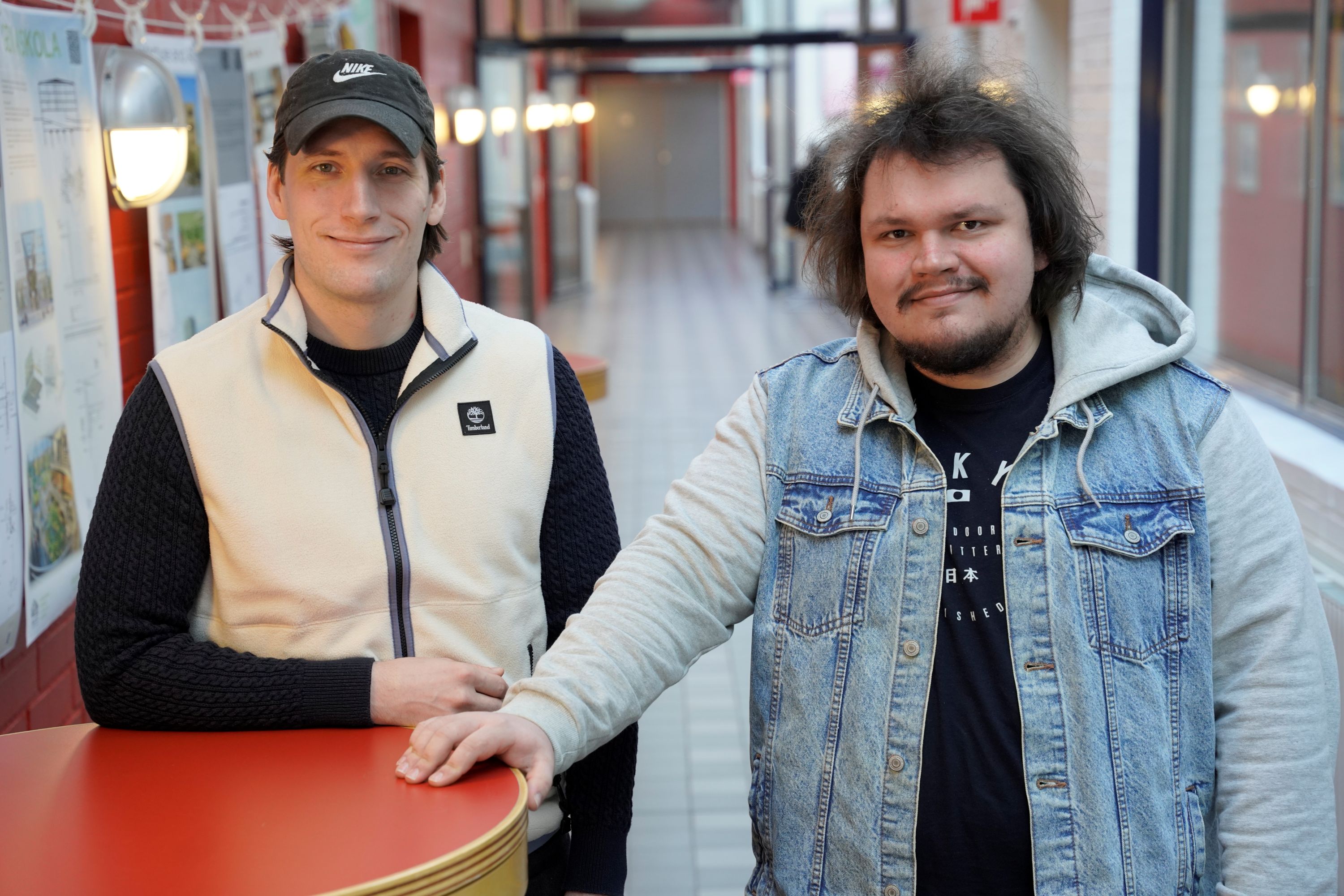
"Engineering student Simon de Reuver and AI master’s student Tàmas Tòth thinks it is really inspiring to work on a project that is so close to real-world applications.
Students are working on their thesis projects in collaboration with NASA
Two students at the School of Engineering at Jönköping University are writing their thesis project in a research field where AI and physics intersect—with ties to NASA.
“Our programmes have given us the tools to tackle such an advanced project,” says Simon de Reuver, who is studying Computer Science and Engineering.
Many people associate NASA with rockets and space missions, but a large part of their work involves advanced data analysis, simulations, and model development. That is precisely where Simon de Reuvers and Tamàs Tóth’s thesis project fit in.
Developing AI models to assist researchers
The duo is developing AI models that follow the laws of physics and can generate synthetic data. The data is used to improve Symbolic Regression—a method that helps researchers identify mathematical relationships underlying complex physical phenomena. The work is being conducted within the framework of the Applied Computational Mathematics Lab (ACML), which is affiliated with Jönköping University and the University of Haifa and collaborates with NASA. Teddy Lazebnik, researcher at ACML and Assistant Professor of Computer Science at the School of Engineering, is the supervisor for Simon and Tamàs.
“The overall idea behind the project is to be able to send new materials into space. The problem is that it is expensive and difficult to test new materials both in space and in a recreated space environment here on Earth. This type of material testing is made easier through computer simulations,” says Teddy Lazebnik.
Simon and Tamàs are therefore developing a computational method for such simulations, and their results will then be used by another lab.
“Inspiring”
“It’s inspiring to work on a project so closely tied to real-world applications. It really motivates us to give it our all, and we’re very grateful to Teddy for giving us this opportunity,” says Tamàs, who is pursuing a master’s degree in AI Engineering.
The collaboration takes place remotely, but the students have regular meetings where they discuss results and the next steps in the project. A typical workday involves implementing and training AI models, analyzing results, and experimenting with new methods. Both Simon and Tamàs emphasize that what they’ve learned during their studies at the School of Engineering has been extremely useful in their thesis work. They see this experience as a major achievement and a step toward future careers in advanced AI, research, and technical development.
“Definitely something I want to continue with”
“This is definitely something I want to continue with. The project has strengthened my desire to work with advanced AI and technical problems, both in research and industry,” says Simon .
Tamàs agrees:
"It’s a fantastic opportunity to contribute to research that can actually be used in real-world applications. That’s exactly the kind of work I want to do in the future."
- Assistant Professor Computer Science
- School of Engineering
- teddy.lazebnik@ju.se


