


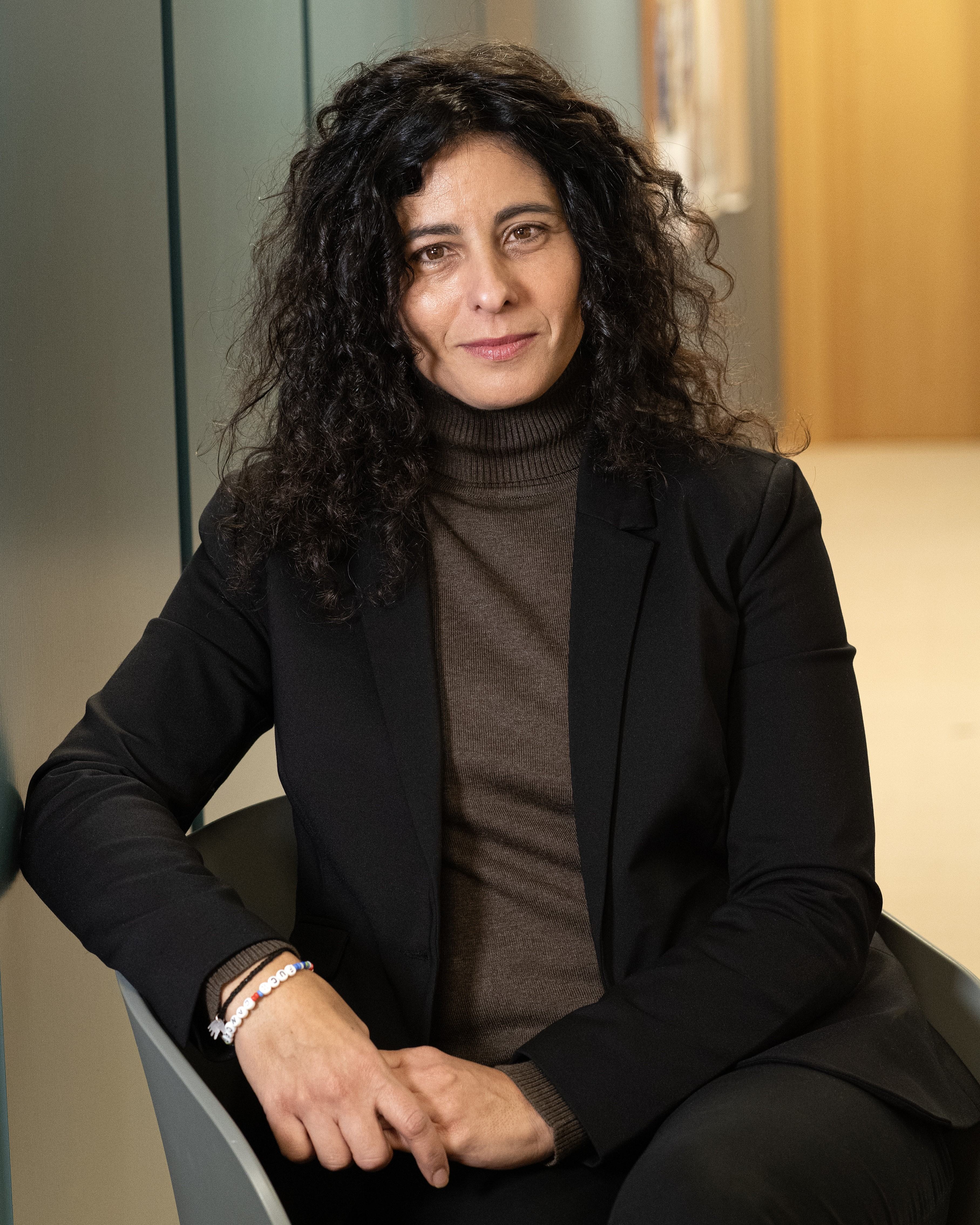
Einav Perez-Andersson, PhD in Business Administration
"You take a risk if you stand still"
Recently graduated PhD, Einav Perez-Andersson, was surprised to find that when she examined the data maturity of the county’s business sector, almost no organizations had begun working with AI.
—All companies should make some kind of decision about their future when it comes to new technology.
“Transform or be transformed” — these are the dramatic tones in the title of Einav Perez-Andersson’s new PhD thesis on organizations and AI. “It’s not really that dramatic,” she explains when we meet in her office at JTH to talk about her research.
—It's a bit pointed, but — now the technology is here. Some industries have to change, others will change, she says, recalling the classic concept of the “Kodak moment” that describes how the venerable company misjudged and underestimated the transition to digital photography. So, is this an industrial revolution underway? You can only see that after many years, says Einav, who has a doctorate in business administration and combines economic issues with technical research at JTH.
—Technology is revolutionary, but does it affect everything in our lives, no. Not yet. There are too many questions that we don't have a handle on yet — AI might be banned, she says a bit provocatively but ends up saying that technology will definitely change how we do things.
— We have a long way to go, and no one is really there yet, she continues, reflecting on her findings in her thesis, which is based on work with both the public sector and the private sector.
A strategy is required
In Jönköping Municipality, Einav Perez-Andersson has met with all the heads of administration and has particularly delved into the possibilities of AI at the Technical Office (Tekniska kontoret), in an effort to improve information to residents about snow removal routes. As for the private sector, she examined the maturity level of 246 manufacturing companies, placing them on a scale of four levels. While a few are relatively advanced, many have only just started or haven’t begun working with AI at all.
We focused on the technical maturity that companies need to implement AI. Many have large amounts of data, but it is often unstructured — for example, stored in Excel documents. Structuring and making this data usable is the foundation for AI. We also observed outdated systems and isolated ‘system islands’ that don’t communicate with each other. The big question is: how do you bring it all together? When it comes to obstacles, the difference between the public sector and the private sector is not that big, she says.
—It’s IT systems that don’t talk to each other, and you may have data, but it’s unstructured. The most important challenge, however, is the people,” explains Einav Perez-Andersson.
—It’s about knowledge, education, and culture. There’s a great need to scale up people. Some businesses are doing well and feel no need to change — like Kodak. You can choose to lead or follow, but you need to evaluate your position. Staying put carries risks.
Einav wants to inspire rather than scare with her thesis, but she is surprised that Sweden has not progressed further in AI. “Countries like Germany, France, and the UK are further ahead,” she explains.
—We are a wealthy country, but there are many fears. My gut feeling is that culture plays a role, especially regarding privacy issues. In some other countries, there are fewer regulatory concerns. Now Einav Perez-Andersson wants to help businesses be more active and improve the use of data, and she is now expanding her research on data maturity to 500 companies.
—There is a lot to improve in daily work, such as removing boring and repetitive tasks in administration and production. You can start simply, but every company needs to “map” the current situation, the next steps and have a strategy. We can’t just wait she says, and sends a thinkable quote about the issue.
“Organizations can welcome AI, prepare for it, and ride it to new heights of innovation and prosperity, or ignore the changing tide, miss the wave, and be left behind treading water.”
— Robert D. Atkinson, 2019


