


COMPASS
Facts
School:
School of Engineering
Industrial partners:
Husqvarna AB, FläktGroup Sweden AB, Lindbäcks AB, OBOS Sweden AB
Project duration: 2026 - 2029
Research team:
Paraskeva Wlazlak, Associate Professor
Kristina Säfsten, Professor
Sinah Malz, PhD Student

Performance indicators and shared understanding supporting sustainable and circular product realisation
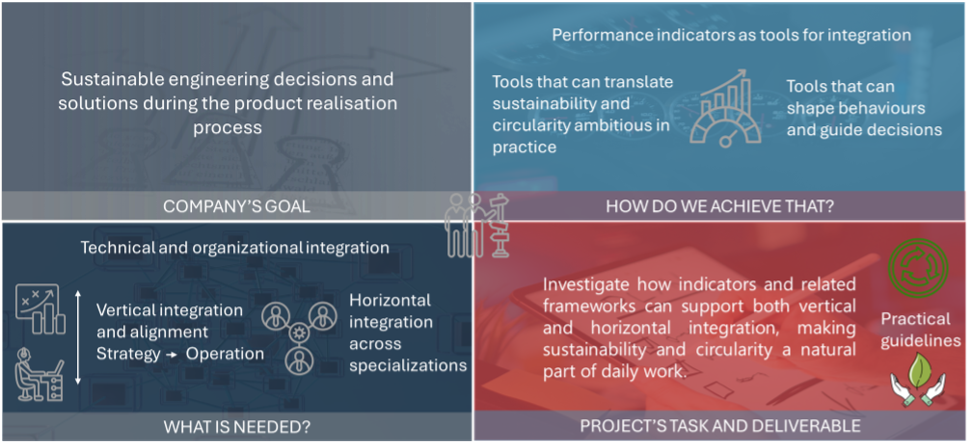
Compass explores how sustainability and circularity performance indicators can make strategies understandable and usable in everyday decision-making. By linking strategy with practical action and bridging boundaries between different areas of expertise, the project provides a shared language and concrete support for integrating sustainability into product development.
Many companies struggle to translate strategic sustainability goals into daily engineering work. This project studies the selection and implementation of sustainability and circularity performance indicators, with a focus on their practical use in product realisation. Attention is given to how indicators are aligned vertically across organisational levels and horizontally across functions and specialisations, as well as how they are adapted to different organisational contexts.
The project emphasises not only the selection of indicators but also the equally challenging and important aspects of their implementation and use in practice. Through collaboration with industry partners, the project further explores the use of performance indicators as tools to support shared understanding, both vertically and horizontally, when operationalising sustainability and circularity in product realisation.
Importance of the Project
This project is important because many manufacturing companies struggle too perationalise sustainability and circularity in everyday product realisation activities. By studying how performance indicators are selected and implemented across organisational levels and functions, the project addresses a critical gap between strategy and practice. For industrial companies, the project provides knowledge that supports better coordination, decision-making, and alignment around sustainability goals. For society, the project contributes to more effective integration of sustainability and circularity in product realisation, supporting long-term environmental goals. The generated knowledge is valuable forengineers, managers, and sustainability professionals working with performance measurement in organisational settings.
Expected results of GRACE: COMPASS
Practical guidelines for selecting, implementing and using sustainability and circularity indicators that support shared understanding and collaboration for integrating sustainability into product realisation.
Do you want to know more about the project?
- Associate Professor Integrated Product and Production Development
- School of Engineering
- paraskeva.wlazlak@ju.se
- +46 36-10 1612
%20morkbla-logo.png)


