


Intellect
Facts
School:
School of Engineering (JTH), Jönköping University
Industrial partners:
FläktGroup
Project duration: 2026 - 2029
Research team:
Milad Ashourpour, Assistant Professor
Mahdis Nejatnia, PhD Student

Intelligent Technology for Equipment Lifecycle Enhancement and Circular Technologies
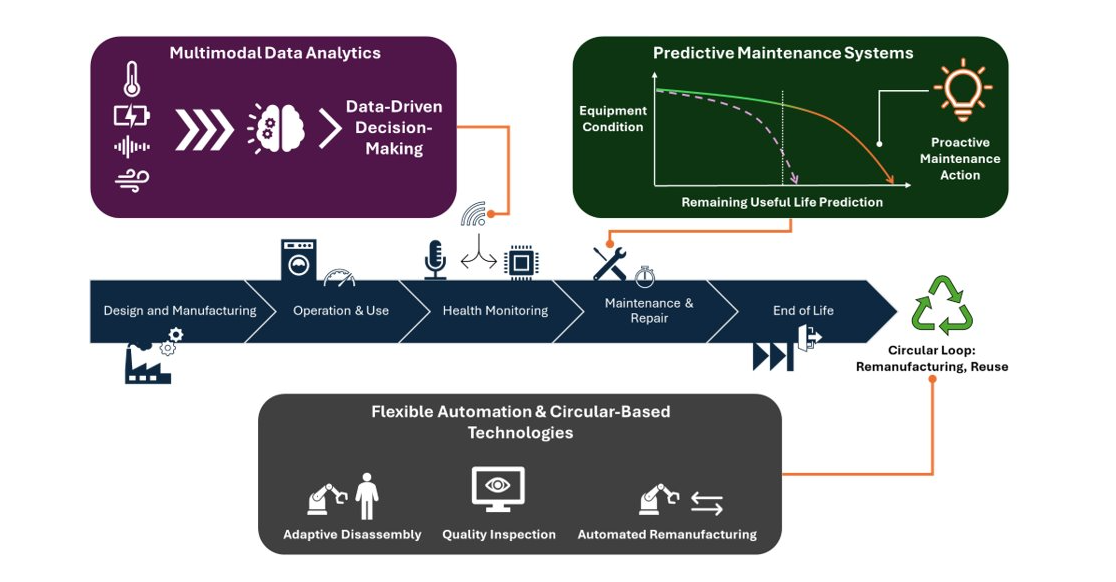
Intellect is a project within the research profile GRACE to develop and validate integrated frameworks combining multimodal sensor data analytics with flexible automation to address critical haps in how industrial companies systematically leverage digital technologies for circular economy in practice.
Transitioning to sustainability and circular economy is paramount for tackling challenges such as climate change and the degradation of natural resources. The In2Circ project addresses the information needs in product and production development to increase the ability of industrial companies to develop products and processes for the sustainable circular economy. The project aims to discover how circular strategies are used and what information pertains to their realization. Questions like how the information should be gathered, analyzed, and managed are addressed. Tool, methods, and technology to keep the information updated and available will be proposed and evaluated in the project. The project is expected to increase the speed at which companies can transition into the circular economy.
Importance of the Project
Industrial equipment failures cost industries billions annually while generating unnecessary waste and emissions. As manufacturing sectors facegrowing pressure to operate more sustainably, the gap between available technologies and practical application remains wide. Intellect closes this gap by producing validated frameworks that practitioners can apply, giving engineers and decision-makers concrete tools for monitoring equipment health, extending operational lifetimes, and reducing material waste. The generated knowledge benefits anyone working at the intersection of industrial maintenance,automation, and sustainability, offering evidence-based guidance rather than theoretical recommendations, all grounded in real industrial data.
Expected results of _INTELLECT
Intellect benefits two primary groups. Industrial practitioners, particularly maintenance engineers, production managers, and sustainability officers, gain validated frameworks and implementation guidelines for integrating sensor analytics and automation into their operations and products. Academic researchers gain field-validated methodologies, published findings, and demonstrated platforms that advance the scientific edge beyond theoretical proposals. Secondary beneficiaries include equipment manufacturers seeking longer product lifetimes and policymakers working toward circular economy targets. By grounding outcomes in real industrial environment, the project ensures its results are immediately transferable rather than confined to laboratory conditions.
Do you want to know more about the project?

- Assistant Professor Integrated Product and Production Development
- School of Engineering
- milad.ashourpour@ju.se
- +46 36-550 2412
%20morkbla-logo.png)


